
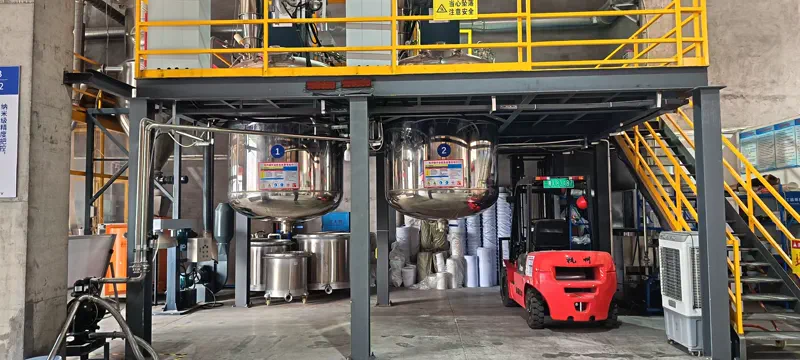
Overview
Acrylic coatings are the premium choice when colour, gloss and long-term appearance matter. The chemistry — an acrylic resin crosslinked with an isocyanate or melamine — gives exceptional UV stability and gloss retention with no chalking or yellowing over a service life measured in decades.
The range at Delshine spans three distinct tiers. Acrylic primers and finishes are the workhorses. Acrylic polyurethane topcoats add the toughness and chemical resistance of a polyurethane film. Fluorocarbon finishes — the PVDF-based system — are the ultimate in colour and gloss retention, used on landmark buildings and infrastructure where a coating must still look new after 25 years.
Acrylic and fluorocarbon systems are the natural choice for steel structures, bridges, ships, and any exterior where the appearance is part of the specification and not just the protection.
Fluorocarbon Varnish: Clear finish
Product identification
The identifiers below are the ones printed on the drum and quoted on the purchase order. Always order and dispatch by code, because the grade and the zinc or temperature variant cannot be inferred from the trade name alone.
| Product code | — |
|---|---|
| Trade name | Fluorocarbon Varnish |
| Category | Acrylic coatings |
| System role | Topcoat - exposed finish of the system |
| Manufacturer description | Clear finish |
Where this product is used
- Exterior architectural steel and landmark building facades
- Bridge handrails, balustrades and structural steelwork
- Marine topsides and superstructure coating
- Road marking paint on highways and urban roads
- Overhead steel structures and cranes
- Fluorocarbon facades on high-rise and commercial buildings
- Roofing and canopy steelwork
- Decorative metalwork, railings and architectural features
How it works in the coating system
The topcoat is the visible, exposed layer of the system. It provides the colour, the gloss and the final resistance to weathering, UV, chemicals and mechanical wear — the properties the specifier and the owner actually see and rely on.
Because it is the only coat fully exposed to the service environment, the choice of topcoat chemistry is the single decision that most affects how a coating system ages. A system that is under-specified at the topcoat will look good on day one and disappoint in five years.
Purpose in the system: The final coat of the system, applied over the intermediate coat.
Technical properties
The values below are the typical published range for this product family. The exact figures for your batch are confirmed on the batch certificate and the current technical data sheet.
| Role in the coating system | Acrylic / acrylic-polyurethane / fluorocarbon coating — primer, finish or road marking |
|---|---|
| Volume solids | 30–70 % |
| Mixing ratio by volume | 1:1 or 2:1 for the two-pack polyurethanes; single component for acrylics |
| Typical dry film thickness | 30–60 µm per coat; 80–120 µm for road marking |
| Theoretical coverage | 8–14 m²/litre per coat |
| Application methods | Airless spray · conventional spray · brush · roller · road marking machine |
| Application temperature window | 5–40 °C, minimum 3 °C above dew point |
| Suitable substrates | Prepared steel, concrete, masonry, asphalt road surfaces |
| Finish / appearance | Full RAL colour range; high gloss, satin, metallic |
| Principal resistance | Weather, UV, colour retention, road wear |
| UV resistance | Excellent — fluorocarbon and acrylic-polyurethane grades are the UV-stable choice |
| Adhesion to prepared steel | > 3 MPa pull-off on prepared steel |
| Salt spray performance | > 1,000 h for the full system |
| Chemical resistance | Moderate — not for solvent or fuel immersion |
| Abrasion resistance | Good for road marking; moderate for wall finishes |
| Flash point | 5–25 °C |
| Shelf life | 12 months unopened |
| Density | 1.00–1.35 g/cm³ |
| Pack sizes | 1 kg–20 kg kits; 200 kg drums |
| Reflective bead content | 0.18–0.25 kg/litre for the road marking grades |
Surface preparation
- Abrasive blast steel to Sa 2½ (ISO 8501-1). For architectural work and fluorocarbon systems, blast to Sa 3 and check the surface profile against the coating manufacturer's requirement, typically 40-70 µm.
- Ensure all surfaces are free of mill scale, rust, weld spatter, oil and grease. Weld spatter must be removed and the area abraded.
- Round all edges to a minimum 2 mm radius. This is a visible quality item on architectural work as well as a durability one.
- For stainless steel or aluminium, use a dedicated wash primer or non-ferrous etch primer — do not use a steel system.
- Control conditions during application: substrate at least 3 °C above dew point, ambient above 10 °C, humidity below 80%.
- Mask and plug before coating, and remove masking tape while the coating is still slightly tacky for a clean edge.
Application procedure
Apply by spray for the best appearance and film uniformity, by roller for large flat areas, or by brush where access is restricted.
Aim for a consistent wet film across the whole area. Overlapping passes should be kept wet to avoid a lap line in the finish.
Plan the work so that the coating is applied in manufacturable quantities — a full kit should be mixed and used within the pot life, and any surplus should be discarded rather than saved.
Mixing, ratio and induction time
Two-pack finishes are mixed at the ratio stated on the data sheet, commonly 4:1 or 5:1 by volume for epoxy and 3:1 for polyaspartic and acrylic polyurethane. Use a proper mixing gauge — a mix that is even a few percent off ratio will cure differently and may not meet the published properties.
Cure, recoat window and service readiness
Surface dry in 2 to 6 hours, recoatable in 12 to 24 hours, and fully cured in 7 days. Do not place the structure into service, immersion or heavy loading before full cure, even though the surface will feel dry much earlier.
Coverage and thickness calculation
Typical dry film thickness is 60-100 µm for a conventional finish and 40-60 µm for a high-build polyurethane finish. At 80 µm, one litre covers roughly 8-10 m². Two coats are usually specified where colour, gloss uniformity or coverage hiding matter.
Technical note. Coverage (m²/litre) = (volume solids × 10) / DFT (µm)
Worked example
| Specified DFT | 45 µm |
|---|---|
| Volume solids | 50 % |
| Theoretical coverage | 11.11 m²/litre |
| Total for the area | 100 m² → 1111.1 litres |
Advantages
- Outstanding UV and weathering resistance with minimal chalking, fading or yellowing.
- Excellent gloss retention and colour stability over long service periods.
- Fast cure and good throughput — acrylic coatings can often be overcoated within a few hours.
- Good adhesion and flexibility, with excellent edge retention.
- Fluorocarbon finishes provide the best-in-class colour and gloss retention available in the market.
- Wide colour range, including RAL, BS and custom-matched shades for architectural projects.
Limitations and precautions
- Aromatic acrylic finishes will discolour; aliphatic grades are required for UV-exposed service.
- Coverage is relatively thin compared with high-build epoxy — these systems rely on film build from multiple thin coats.
- Fluorocarbon systems are expensive and the coating must be applied by a trained applicator to perform as designed.
- Not suited to immersion in aggressive chemicals without a specific grade.
- Acrylic coatings cure poorly in cold or humid conditions and will blush if applied outside the recommended window.
Storage and shelf life
- Store in original sealed containers in a cool, dry, ventilated store between 5 °C and 30 °C.
- Keep the hardener component away from moisture — it reacts with atmospheric water.
- Protect from direct sunlight and do not store above 40 °C.
- Rotate stock first-in-first-out and observe the labelled shelf life, typically 12 months unopened.
Safety, PPE and ventilation
- Wear chemical-resistant gloves, goggles and suitable protective clothing.
- Use an organic-vapour cartridge respirator when spraying, and supply ventilation for the coating area.
- Keep away from heat and ignition sources; solvents are flammable.
- Do not spray in windy conditions outdoors without appropriate containment and respiratory protection.
- Collect solvent waste and dispose of it through a licensed contractor.
Quality control and inspection
- Check colour and gloss against the approved sample or RAL reference before starting the full area.
- Measure DFT and check for thin spots, particularly over welds, edges and connections.
- Inspect the finished surface for lap marks, sag, orange peel, dust inclusion and solvent entrapment before accepting the coat.
Pricing and how to order
Delshine quotes this product per square metre at a specified dry film thickness, or per drum/litre depending on the project. The material cost is usually the smallest part of the installed cost — surface preparation, access and application labour dominate. Send us the substrate, the service conditions and the required DFT and our technical team will return a full system recommendation with a firm price.
Acrylic and fluorocarbon coatings are quoted per square metre at a stated dry film thickness, with colour and sheen usually driving the price difference. Fluorocarbon is several times the price of a standard acrylic finish — a 2,000 m² facade moves from a modest figure to a significant one purely by changing the topcoat, which is why the specification stage matters so much.
Frequently asked questions
The questions below are the ones our technical team is asked most often about this product family.
What is fluorocarbon coating and why is it used on buildings?
Fluorocarbon (PVDF) coating uses a resin containing a very high proportion of fluorine atoms. The fluorine-fluorine bond is one of the strongest bonds in chemistry, which makes the coating exceptionally resistant to ultraviolet light, chemicals and chalking. That is why fluorocarbon is the standard for landmark towers and infrastructure where the coating must retain its colour and gloss for 25 years or more.
How many coats does an acrylic coating system need?
Typically a primer at 40-60 µm followed by one or two finishing coats at 40-60 µm each, giving 120-180 µm total. Architectural fluorocarbon systems typically use a two-pack epoxy primer plus two coats of fluorocarbon finish, which is the specification that achieves long-term colour retention.
Can acrylic coating be applied over old paint?
Only after the old coating has been assessed. If the existing coating is sound, it can be abraded, cleaned and overcoated with a compatible primer. If it is failing, it must be removed and the steel prepared properly. Always run a trial patch and an adhesion test — a failed overcoat is far more expensive than the preparation it replaced.
Is road marking paint the same as a normal acrylic coating?
No. Road marking paint is a special formulation designed for extreme abrasion from tyres, high reflectivity for night visibility, and rapid cure so that roads can be reopened quickly. It also has to withstand the reflective glass bead embedded in the paint. It should be applied with the dedicated road marking application equipment, not as a conventional coating.
How long does an acrylic coating last?
A good quality two-pack acrylic polyurethane topcoat over a sound primer gives 15-25 years exterior service with excellent colour and gloss retention. Fluorocarbon systems give 25-30 years or more. Coastal and industrial atmospheres reduce this, and poor preparation shortens it dramatically.
Can acrylic coatings be used on stainless steel?
Yes, but they need a non-ferrous etch or wash primer rather than a conventional steel primer, and the surface must be degreased and lightly abraded. This is covered by the modified epoxy non-ferrous primer in the range, which is zinc-yellow in colour specifically for that job.
Related products
These products are normally used in the same system as the product described above.
Comments (0)
Real feedback from engineers and contractors who work with these systems every day.