
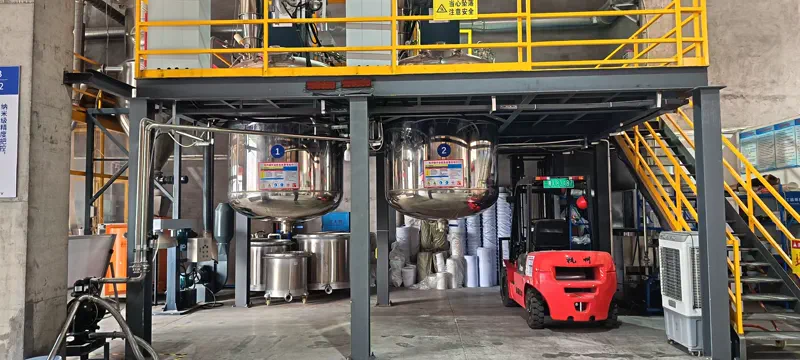
Overview
Aerogel insulation coating is a high-performance thermal insulation material that delivers a fraction of the heat transfer of conventional mineral or polyurethane insulation, in a thin, paintable coating that can be applied directly to steel, concrete, masonry and metal surfaces.
The science behind it is the nanoporous silica aerogel itself: an open-cell structure that is 95% air by volume, with pores so small that air molecules cannot move freely through them. That effectively breaks the conductive path that carries heat through every other insulation, which is why an aerogel coating only a few millimetres thick can cut heat loss dramatically.
Delshine manufactures the full range: thermal insulation grades for hot surfaces and building envelopes, water-based acoustic grades for sound dampening, and transparent alkali-resistant sealing primers that let the coating adhere to masonry without the efflorescence staining that ruins so many façade jobs.
Water-Based Acoustic Aerogel Coating: Applied to interior walls or structural surfaces to dampen sound waves and provide acoustic insulation, using an eco-friendly, water-based aerogel formula.
Product identification
The identifiers below are the ones printed on the drum and quoted on the purchase order. Always order and dispatch by code, because the grade and the zinc or temperature variant cannot be inferred from the trade name alone.
| Product code | DSAG-202 |
|---|---|
| Trade name | Water-Based Acoustic Aerogel Coating |
| Category | Aerogel coatings |
| System role | Topcoat - exposed finish of the system |
| Manufacturer description | Applied to interior walls or structural surfaces to dampen sound waves and provide acoustic insulation, using an eco-friendly, water-based aerogel formula. |
Where this product is used
- Retrofit insulation of exterior walls, roofs and parapets
- Insulation of pipework, valves, flanges and heat exchangers
- Protection of industrial furnaces, exhaust lines and boilers
- Acoustic dampening of interior walls, ceilings and structural steel
- Fireproofing of marine bulkheads and offshore structures
- Cryogenic protection of LNG, LPG and liquid nitrogen tanks
- Insulation of HVAC ducting and air-handling equipment
- Reduction of thermal bridging on steel framing and concrete slabs
How it works in the coating system
The topcoat is the visible, exposed layer of the system. It provides the colour, the gloss and the final resistance to weathering, UV, chemicals and mechanical wear — the properties the specifier and the owner actually see and rely on.
Because it is the only coat fully exposed to the service environment, the choice of topcoat chemistry is the single decision that most affects how a coating system ages. A system that is under-specified at the topcoat will look good on day one and disappoint in five years.
Purpose in the system: The final coat of the system, applied over the intermediate coat.
Technical properties
The values below are the typical published range for this product family. The exact figures for your batch are confirmed on the batch certificate and the current technical data sheet.
| Role in the coating system | Thermal and acoustic insulation coating — ultra-thin, nano-porous |
|---|---|
| Volume solids | 18–45 % depending on grade |
| Mixing ratio by volume | Single component, ready to use · 2:1 by volume for the 2-pack grades |
| Typical dry film thickness | 0.5–3.0 mm (thermal grades); 0.2–1.0 mm (acoustic grades) |
| Theoretical coverage | 1.0–3.0 m²/litre per coat depending on grade |
| Application methods | Brush · roller · airless spray |
| Application temperature window | 5–40 °C, apply above 5 °C dew point |
| Suitable substrates | Concrete, masonry, render, plaster, metal (over a compatible primer) |
| Finish / appearance | Matt, white or tinted; the transparent primer is colourless |
| Principal resistance | Thermal insulation, sound absorption, weather and UV |
| UV resistance | Excellent — the aerogel binder is UV stable and does not chalk |
| Adhesion to prepared steel | Good on alkaline masonry after the sealing primer |
| Salt spray performance | Not applicable indoors; the exterior grade passes 1,000 h salt spray |
| Chemical resistance | Resistant to alkalis and neutral salts; not to strong acids |
| Abrasion resistance | Low — not for traffic areas or high-abrasion zones |
| Flash point | Not applicable (water-based) |
| Shelf life | 12 months unopened, protected from freezing |
| Density | 0.6–1.1 g/cm³ |
| Pack sizes | 5 kg · 20 kg · 200 kg drums |
| Thermal conductivity | λ = 0.013–0.021 W/(m·K) at a 2 mm film |
| Acoustic performance | NRC 0.55–0.75 for the acoustic grades |
| Solar reflectance | Solar reflectance 0.80–0.87 for the white exterior grade |
Surface preparation
- Clean the substrate thoroughly and remove all loose material, oil, grease and salt. Aerogel coatings bond to clean, dry surfaces.
- Repair any cracks, joints and defects first. Aerogel is a coating, not a gap filler — movement cracks will telegraph straight through the finish.
- Remove all rust and scale from steel, then abrade or grit-blast to a clean surface. Prime metal with a corrosion-inhibiting primer to prevent undercutting.
- On masonry and concrete, apply the transparent alkali-resistant sealing primer (DSAG-301/302) to block moisture and efflorescence. Without it, alkali salts will migrate through the coating and cause blistering and staining.
- Ensure the substrate is completely dry. Moisture trapped under an insulation coating causes blistering and destroys the performance.
- Mask off fittings, flanges, valves and any element that must later be removed or serviced.
Application procedure
Apply by spray for the best appearance and film uniformity, by roller for large flat areas, or by brush where access is restricted.
Aim for a consistent wet film across the whole area. Overlapping passes should be kept wet to avoid a lap line in the finish.
Plan the work so that the coating is applied in manufacturable quantities — a full kit should be mixed and used within the pot life, and any surplus should be discarded rather than saved.
Mixing, ratio and induction time
Two-pack finishes are mixed at the ratio stated on the data sheet, commonly 4:1 or 5:1 by volume for epoxy and 3:1 for polyaspartic and acrylic polyurethane. Use a proper mixing gauge — a mix that is even a few percent off ratio will cure differently and may not meet the published properties.
Cure, recoat window and service readiness
Surface dry in 2 to 6 hours, recoatable in 12 to 24 hours, and fully cured in 7 days. Do not place the structure into service, immersion or heavy loading before full cure, even though the surface will feel dry much earlier.
Coverage and thickness calculation
Typical dry film thickness is 60-100 µm for a conventional finish and 40-60 µm for a high-build polyurethane finish. At 80 µm, one litre covers roughly 8-10 m². Two coats are usually specified where colour, gloss uniformity or coverage hiding matter.
Technical note. Coverage (m²/litre) = (volume solids × 10) / DFT (µm)
Worked example
| Specified DFT | 2000 µm |
|---|---|
| Volume solids | 35 % |
| Theoretical coverage | 0.17 m²/litre |
| Total for the area | 100 m² → 17.5 litres |
Advantages
- Extremely low thermal conductivity for the applied thickness — far less space than mineral wool or conventional PU insulation.
- Thin, paintable and light, so it adds almost no dead load to pipelines, plant rooms or retrofitted façades.
- Water-based and low-VOC formulations available, with no hazardous solvent odour in occupied buildings.
- Excellent thermal shock resistance — the coating survives rapid temperature cycling without cracking.
- Can be applied over complex geometry without the seams, joints and thermal bridges of blanket or board insulation.
- Hydrophobic grades shed water, keeping the substrate dry and preserving the insulating value over time.
Limitations and precautions
- Cost per square metre is significantly higher than conventional insulation — justify it against energy savings or process temperature control, not on first cost alone.
- Not every substrate and every operating temperature has an aerogel solution. Check the temperature rating of the exact grade before specifying.
- Surface preparation is critical; contamination will cause loss of adhesion and eventual blistering.
- Some grades require careful film build to reach the rated thermal performance — under-application means under-performance.
- Mechanical damage to a thin coating can compromise the insulation path; protect high-traffic or high-impact areas.
Storage and shelf life
- Store unopened drums between 5 °C and 30 °C in a dry, shaded store, away from direct sunlight and freezing.
- Do not allow the coating to freeze — frozen material must be thawed and mechanically re-mixed before use.
- Stir thoroughly before opening and during application; the material settles during storage.
- Use first-in-first-out stock rotation and observe the shelf life printed on the label.
Safety, PPE and ventilation
- Water-based grades are low hazard, but always wear gloves, safety goggles and a dust mask when mixing or sanding.
- Provide ventilation when applying in confined spaces, even with water-based material.
- Contain overspray and do not discharge wash water into surface water systems.
- Some high-temperature grades contain solvents — read the specific safety data sheet before handling.
Quality control and inspection
- Check colour and gloss against the approved sample or RAL reference before starting the full area.
- Measure DFT and check for thin spots, particularly over welds, edges and connections.
- Inspect the finished surface for lap marks, sag, orange peel, dust inclusion and solvent entrapment before accepting the coat.
Pricing and how to order
Delshine quotes this product per square metre at a specified dry film thickness, or per drum/litre depending on the project. The material cost is usually the smallest part of the installed cost — surface preparation, access and application labour dominate. Send us the substrate, the service conditions and the required DFT and our technical team will return a full system recommendation with a firm price.
Aerogel coating is specified per square metre of surface at a defined dry film thickness, and the price is driven mainly by the required build. A 2-3 mm build on a 500 m² pipeline section typically needs several drums plus primer and topcoat — request a full system quote including surface preparation rather than a material-only price.
Frequently asked questions
The questions below are the ones our technical team is asked most often about this product family.
What is aerogel coating used for?
Aerogel coating is used wherever heat needs to be stopped in a thin layer: insulating pipework and heat exchangers, retrofitting exterior walls and roofs, protecting furnaces and exhaust lines, and acoustic dampening on interior surfaces. The advantage over conventional insulation is thickness — a few millimetres of aerogel can replace several centimetres of mineral wool.
Is aerogel coating safe for buildings?
Yes. The water-based grades are low-VOC, non-toxic and do not off-gas harmful fumes. The transparent alkali-resistant sealing primer used under the system is specifically designed to keep the coating free of efflorescence staining.
How thick should aerogel coating be?
It depends on the required thermal reduction, the substrate and the operating temperature. Typical applications use between 1 and 5 mm total build, applied in multiple passes. Always work from the thermal conductivity figure and the required heat-loss reduction rather than from a generic film thickness.
Can aerogel coating be painted over?
Yes, and for most architectural and equipment applications it should be. Once fully cured, the surface can be finished with an appropriate topcoat for colour, UV protection or additional chemical resistance.
Does aerogel coating work at high temperatures?
There are dedicated grades for continuous service up to 650 °C for furnaces, exhaust lines and boilers, and cryogenic grades for liquid nitrogen and LNG service down to -196 °C. The standard architectural grade is not a high-temperature product — always specify the correct grade.
How long does aerogel coating last?
With correct preparation and the right grade for the service condition, an aerogel insulation system typically gives 10-25 years. Life is limited far more by surface preparation and premature water ingress than by the coating itself.
Related products
These products are normally used in the same system as the product described above.
Comments (0)
Real feedback from engineers and contractors who work with these systems every day.